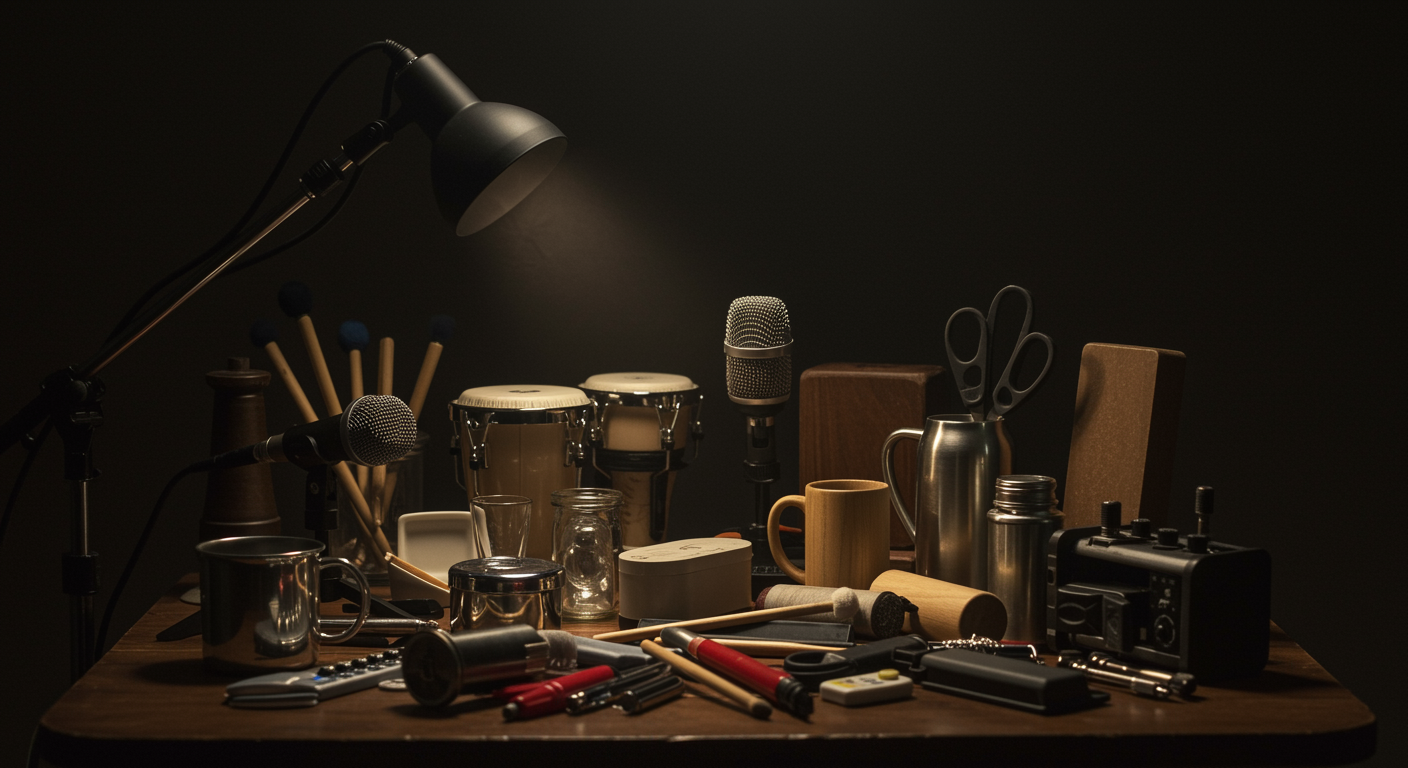
Utilizing everyday objects as percussive music samples unlocks a vast spectrum of unique sonic textures, offering musicians and producers an accessible and creative avenue to infuse their tracks with distinctive rhythms and unconventional timbres, ranging from the subtle taps of kitchenware to the resonant thuds of furniture, all captured and manipulated for musical composition.
The Unique Sonic Palette of Found Sounds
The practice of integrating everyday objects into musical compositions as percussive elements has long been a secret weapon for sound designers and avant-garde musicians, but it’s increasingly finding its way into mainstream production. What makes a simple clatter of keys or the rustle of a plastic bag so compelling when transformed into a rhythmic component? It’s the inherent organic quality and unexpected character these “found sounds” bring. Unlike synthesized drums or traditional percussion, everyday objects carry a certain narrative and an imperfect authenticity that can make a track feel more grounded, experimental, or even whimsical. For a deeper dive into the methodology, consider a creative guide for deconstructing found sounds musical samples to unlock even more potential. This approach allows creators to move beyond conventional drum sounds, fostering a truly distinctive sonic identity for their music.
Beyond novelty, the acoustic properties of everyday objects offer a richness that is hard to replicate. A metal bowl struck with a spoon might yield a complex decay with interesting overtones, while a stack of books dropped onto a wooden floor could provide a weighty, impactful thud. These objects produce sounds that are often rich in transient information and contain unique spectral characteristics that can cut through a mix in surprising ways. Exploring this sonic palette encourages a deep dive into listening, not just for what an object is, but for how it sounds when interacted with in various ways—scraped, tapped, shaken, or dropped. This careful attention to detail transforms mundane items into powerful musical instruments waiting to be discovered.
Selecting the Right Objects for Percussion
Choosing which everyday objects to sample for percussive music is a crucial first step in crafting an effective sound library. Not all objects are created equal when it comes to their sonic potential. The ideal candidates are those that exhibit interesting resonance, clear attack, or a unique textural quality. Think about materials: metals often yield bright, sustained tones; wood typically offers warm, punchy sounds; plastics can provide crisp clicks or rattling textures; and glass often creates delicate, bell-like rings or sharp, brittle impacts. Experimentation is key, but starting with objects that have a distinct sound profile can save time and enhance the quality of your samples.
Consider the purpose of the sound within a track. Do you need a sharp, short attack for a hi-hat substitute? A coin dropped on a hard surface or a click of a pen might work. For a snare-like crack, perhaps a magazine slap or a robust clap could fit. If you’re looking for low-end impact akin to a kick drum, striking a sturdy cardboard box or a hollow plastic container might be effective. The shape and size of an object also play a significant role in its sound, influencing its sustain and frequency response. Smaller, denser objects tend to produce higher-pitched, quicker sounds, while larger, hollower items often generate deeper, more resonant tones. Always consider how an object’s physical characteristics translate into audible properties.
Essential Recording Techniques for DIY Samples
Once suitable everyday objects are identified, capturing their sounds with clarity and fidelity is paramount. While professional studios have dedicated equipment, excellent percussive music samples can be recorded with relatively simple setups. The primary goal is to minimize unwanted room reflections and external noise. Recording in a acoustically damped environment, such as a closet full of clothes or a room with heavy curtains and soft furnishings, can significantly improve sound quality by absorbing echoes and reducing reverberation. Even placing a blanket over your head and the object can create a makeshift sound booth. These techniques are essentially a form of field recording for music samples, allowing creators to capture unique sounds from any environment.
Microphone choice and placement are critical. A condenser microphone, even an entry-level USB model, can often capture the detail and nuances of subtle percussive sounds effectively. Position the microphone relatively close to the object, typically within 6-12 inches, to ensure a strong direct sound signal and reduce ambient noise. Experiment with different angles and distances; pointing the mic directly at the point of impact will emphasize the attack, while angling it slightly off-axis might capture more of the object’s body or resonance. For some sounds, like rattles or shakers, a slightly greater distance might be beneficial to capture the full movement. Always record multiple takes and vary the intensity of the hits or interactions to build a dynamic collection of samples.
Transforming Raw Samples Through Audio Processing
Raw everyday objects percussive music samples, while unique, often require post-production to truly shine and integrate seamlessly into a musical context. This stage is where a mundane sound can be sculpted into a powerful rhythmic element or an atmospheric texture. The first step typically involves cleaning up the audio; removing any unintended clicks, pops, or hums, and gentle noise reduction if necessary. Equalization (EQ) is then used to shape the tonal character of the sample. Boosting certain frequencies can enhance the “thwack” of a hit or the metallic shimmer of a bell, while cutting others can reduce boxiness or harshness. For example, a dull cardboard box hit might benefit from a low-mid boost for weight and a high-mid boost for presence.
Dynamic processing, such as compression, is essential for controlling the sound’s attack and sustain. A compressor can make a sample punchier by reducing its dynamic range, ensuring it stands out in a mix without being overwhelmingly loud. Gating can also be useful to precisely cut off unwanted tails or room noise. Beyond corrective processing, effects like reverb and delay can add depth and space, transforming a dry tap into a cavernous echo or a rhythmic pulse. Pitch shifting can dramatically alter the perception of a sound, making a light tap sound like a heavy thud or turning a clatter into an ethereal chime. For those looking to push the boundaries further, exploring granular synthesis with found sounds can craft truly atmospheric soundscapes, transforming simple taps into ethereal textures. Layering multiple processed everyday object samples can create complex, rich percussive textures that are entirely unique.
Integrating Everyday Percussion into Musical Compositions
The true artistry of working with everyday objects percussive music samples lies in their integration into actual musical compositions. These unique sounds can serve various roles, from providing subtle rhythmic embellishments to forming the core beat of a track. For electronic music genres like techno or house, a processed click of a light switch might replace a traditional clap, or a metal clang could become an impactful snare substitute. In ambient or experimental pieces, the long decays of a struck glass or the granular texture of a paper rustle can contribute to the soundscape and atmosphere.
Beyond rhythmic foundations, everyday objects excel in adding textural depth and unique fills. A quick sequence of tapping on a table with varying velocity can create an intricate, humanized groove. They can also be used as Foley effects to enhance storytelling within a song, such as the sound of footsteps providing a rhythmic bed. When incorporating these samples, consider their relationship with traditional instruments. Sometimes, pairing an unconventional percussion sound with a standard kick and bass line can create a compelling contrast, giving the familiar a fresh twist. Experiment with quantizing some samples strictly for precision, while leaving others slightly off-grid to maintain a natural, imperfect feel that is often the charm of found sound percussion.
Building Your Own Found Sound Sample Library
Creating a personal library of everyday objects percussive music samples is a rewarding endeavor that continually enriches your sonic toolkit. Rather than relying solely on commercial sample packs, curating your own collection ensures a unique sound signature for your productions. Start by organizing your recorded sounds logically. Categorize them by object type (e.g., “metal,” “wood,” “plastic”), by sonic characteristic (e.g., “short attack,” “long decay,” “rattle”), or even by their potential musical role (e.g., “snare-like,” “hi-hat,” “FX”). Consistent naming conventions, such as `object_action_take#_BPM` (e.g., `keys_shake_01_120bpm`), will make samples easy to locate later. To further optimize your workflow, explore sample library metadata best practices for organizing and tagging like a pro.
Beyond initial recording and processing, continuously expand and refine your library. As you encounter new objects or discover novel ways to interact with familiar ones, make it a habit to record and add them. Regular maintenance involves reviewing your samples, deleting duplicates or less useful ones, and perhaps re-processing older recordings with new techniques. This iterative process not only keeps your library fresh but also deepens your understanding of sound design. A well-organized, diverse, and personally curated collection of everyday object samples becomes an invaluable asset, sparking new ideas and providing endless creative possibilities for any musical project.