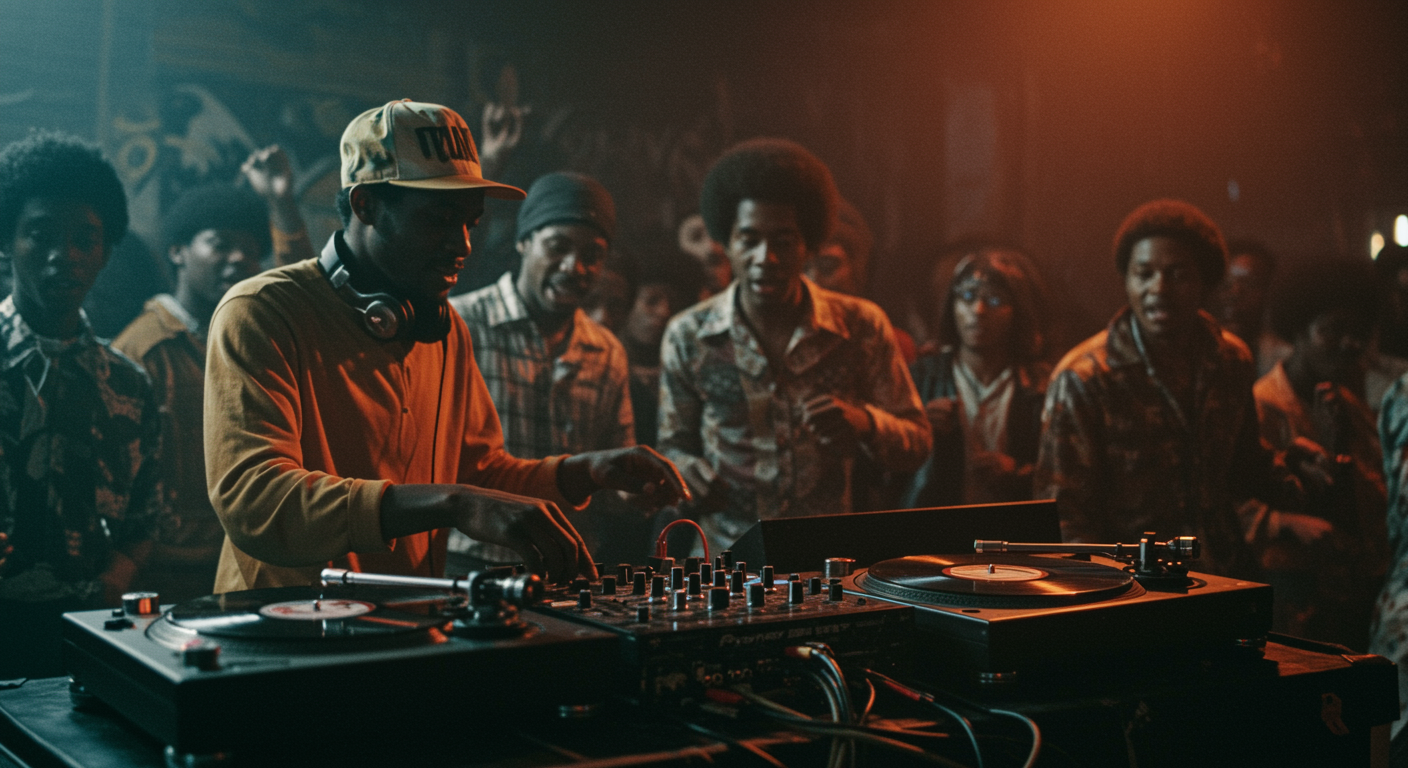
The historical origins of classic hip hop samples are deeply rooted in the late 1970s Bronx, emerging from the innovative techniques of pioneering DJs who manipulated vinyl records to isolate and extend rhythmic “breaks” from funk, soul, and disco tracks, laying the foundational sound for an entirely new musical genre.
Early Pioneers and the Genesis of the Breakbeat
The foundational practice of sampling in hip hop emerged directly from the ingenuity of early DJs in the Bronx during the 1970s. Faced with the challenge of keeping dancers energized, figures like DJ Kool Herc revolutionized party music by isolating the rhythmic, instrumental sections—known as “breaks”—from funk, soul, and rock records. Herc famously used two turntables to extend these brief, high-energy segments by manually switching between identical copies of the same record, repeating the break infinitely. This technique, known as “break-beat DJing,” created continuous grooves that became the bedrock for MCs and breakdancers. The innovative use of drum breaks in hip hop production laid the groundwork for this new genre.
Other pioneers like Grandmaster Flash refined these turntable techniques, introducing “quick mix theory” and “back-spinning” to seamlessly transition between records and precisely cue up breaks. Afrika Bambaataa expanded the sonic palette, drawing breaks from a vast array of genres including European electronic music and movie soundtracks, thereby broadening the definition of what a hip hop beat could be built upon. These early manual manipulations were the conceptual precursors to digital sampling, demonstrating a fundamental desire to repurpose and recontextualize existing musical elements to create new rhythmic foundations.
The Technological Leap: Samplers and Production Evolution
While early hip hop relied on live turntable manipulation, the late 1980s saw a pivotal shift with the advent and increasing accessibility of digital sampling technology. Machines like the E-mu SP-1200 and later the Akai MPC series transformed the production landscape, allowing producers to digitally capture, store, and manipulate snippets of sound. For a modern perspective on these tools, consider understanding sampler plugins. This technological leap moved beyond simply extending breakbeats to the meticulous chopping, looping, and layering of individual drum hits, vocal phrases, and instrumental textures from a myriad of sources.
This new generation of samplers democratized music production, enabling artists to create intricate beats and full instrumentals without needing access to expensive recording studios or session musicians. The limitations of early samplers, such as restricted sampling time and memory, ironically spurred innovation, forcing producers to become incredibly resourceful and inventive with the fragments of sound they could capture. This era cemented the sampler as the central instrument of hip hop production, defining the genre’s characteristic sound and empowering a new generation of sonic architects.
Foundational Genres: The Musical Wellsprings
The rich tapestry of classic hip hop samples drew extensively from a diverse array of musical genres, primarily the deep grooves of 1960s and 1970s funk and soul. Artists like James Brown were an inexhaustible source, with his drum breaks (e.g., “Funky Drummer,” “Cold Sweat”) and iconic vocal samples becoming some of the most sampled elements in music history. Other funk powerhouses such as The Meters, Sly and the Family Stone, and Parliament-Funkadelic provided an abundance of basslines, guitar riffs, and percussive patterns that formed the backbone of countless tracks.
Beyond funk and soul, jazz also played a crucial role, offering intricate melodies, sophisticated harmonies, and distinctive drum patterns from artists like Bob James, Grant Green, and Roy Ayers. Disco records, often overlooked, contributed their driving rhythms and orchestral flourishes. Furthermore, obscure international records, movie soundtracks, and even spoken-word albums provided unique textures and vocal snippets, demonstrating the producers’ expansive musical curiosity. This eclectic borrowing not only provided hip hop with its sonic palette but also introduced new generations to a vast canon of older music, creating a continuous dialogue between past and present sounds.
Defining Moments: Landmark Samples and Their Legacy
Certain samples achieved legendary status, becoming instantly recognizable building blocks that defined the sound of classic hip hop and left an indelible mark on its history. The “Amen Break” from The Winstons’ 1969 track “Amen, Brother” is arguably the most famous, a six-second drum solo that has been sampled thousands of times across hip hop, drum and bass, and jungle. Its raw, energetic feel provided the rhythmic pulse for countless tracks, showcasing the power of a simple drum loop to launch entire subgenres.
Similarly, the drum breaks from James Brown’s “Funky Drummer” and “Give It Up Or Turnit A Loose” became ubiquitous, providing the essential swing and percussive foundation for hits by Public Enemy, Run-DMC, and N.W.A. Beyond drums, memorable instrumental loops like Bob James’ “Nautilus” (used by Run-DMC, Ghostface Killah) or Melvin Bliss’ “Synthetic Substitution” (sampled by Wu-Tang Clan, Gang Starr) became iconic signifiers. These landmark samples not only provided the sonic raw material but also connected disparate tracks and artists, weaving a shared musical heritage that continues to resonate through generations of hip hop production.
Creative Techniques in Early Hip Hop Production
The ingenuity of early hip hop producers extended far beyond simply looping a breakbeat; they developed a sophisticated lexicon of sampling techniques that became integral to the genre’s distinct sound. “Chopping” involved taking a longer sample and slicing it into individual notes, drum hits, or short phrases, then re-arranging them to create entirely new melodies or rhythmic patterns. This allowed for unprecedented creative control, facilitating creative sample manipulation, transforming source material into something wholly original and often unrecognizable from its origin.
Layering was another crucial technique, where multiple samples—a drum break, a bassline, a vocal snippet, a horn stab—were combined to create a richer, more complex soundscape. Producers also experimented with pitch shifting and time stretching, subtly altering the character of samples to fit their musical vision or to create entirely new textures. The manipulation of filters, EQ, and effects further refined these sampled elements, demonstrating that sampling was not merely appropriation, but a high art form of sonic craftsmanship that demanded deep musical understanding and technical skill.
Cultural Resonance: Bridging Eras Through Sound
The practice of sampling in classic hip hop was more than just a production technique; it was a profound act of cultural curation and reinterpretation. By drawing from a vast historical catalog of funk, soul, jazz, and other genres, hip hop artists effectively created a bridge between generations, introducing older musical forms to a new, often younger audience. This intergenerational dialogue fostered a deeper appreciation for music history, highlighting the enduring power and relevance of past recordings.
Sampling allowed hip hop to build upon and simultaneously reinvent musical traditions, asserting its place within a larger continuum of Black American music. It imbued new tracks with a sense of history, nostalgia, and authenticity, creating a sonic lineage that honored its predecessors while forging a distinct identity. This cultural resonance helped solidify hip hop’s status not just as a passing trend, but as a legitimate and evolving art form that continually re-engages with its roots and reshapes the musical landscape.