
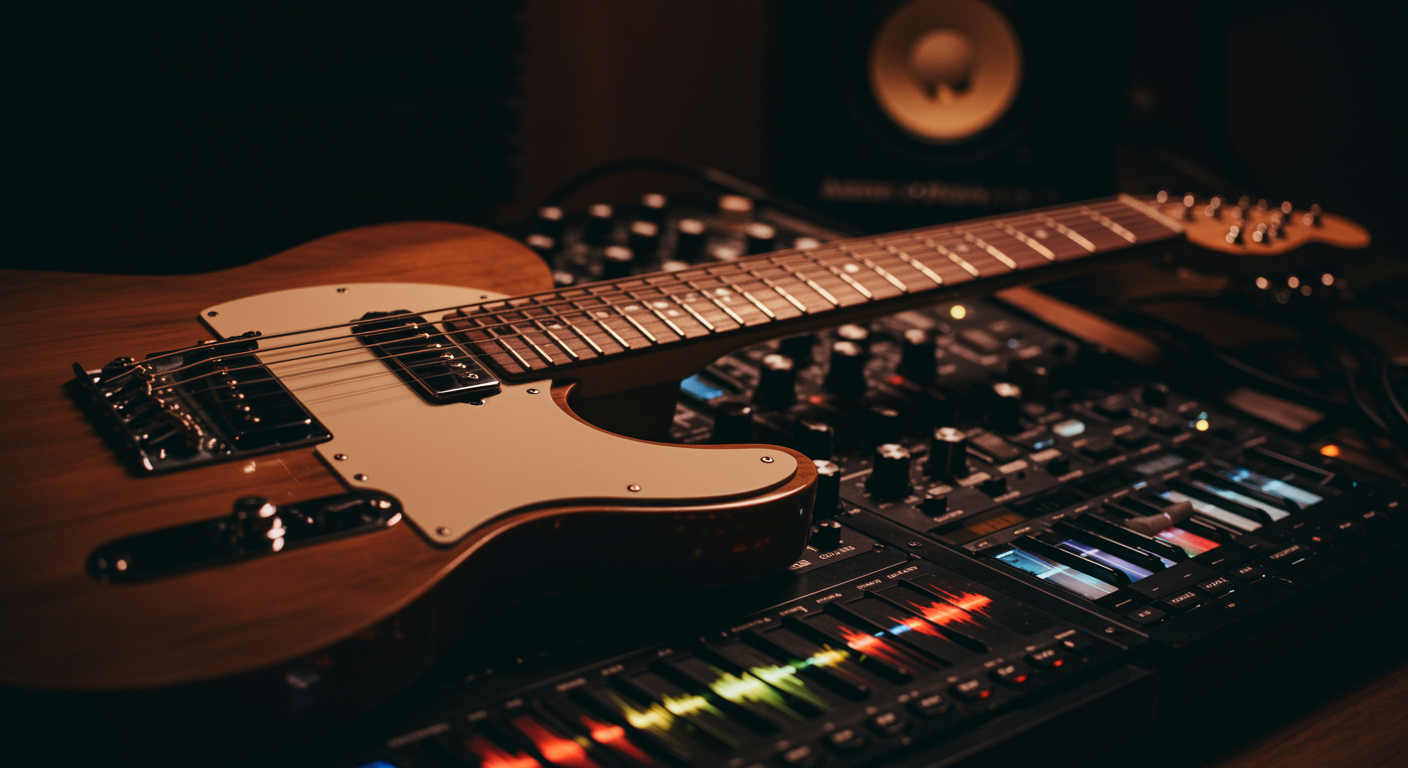
Guitar sample chopping techniques involve dissecting audio recordings of guitars into smaller, individual slices, which are then rearranged and manipulated to forge entirely new rhythms, melodies, and textures. These principles of creative manipulation are also widely applied in other areas, such as vocal sample manipulation techniques, offering a powerful avenue for producers to inject unique sonic character and rhythmic complexity into their music.
Beyond Basic Looping: Rhythmic Disassembly and Reconstruction
While basic looping involves repeating a segment of a guitar recording, advanced guitar sample chopping techniques delve into a more intricate process of rhythmic disassembly and reconstruction. This method moves beyond simply cutting a beat-synced loop; it involves meticulously identifying individual strums, picking patterns, slides, or even transient noises within a guitar performance. By isolating these micro-elements, producers gain a granular level of control, allowing them to rebuild rhythmic phrases that defy conventional timing or create unexpected syncopations. Imagine taking the attack of one chord, the sustain of another, and the release of a third, then resequencing them into a novel rhythmic gesture. This technique often involves working in very small increments, sometimes milliseconds, to extract the most precise components, opening up a world of percussive and melodic possibilities that are distinctly non-guitar in their final output.
The essence of rhythmic disassembly lies in breaking the original context entirely. Instead of seeking a “good loop,” the goal is to find isolated sonic events that can serve as building blocks. This might include extracting the percussive ‘thump’ of a muted string, the resonant tail of an open chord, or the distinct transient of a pick attack. Once isolated, these fragments are then placed on a grid, often without regard for their original timing or pitch relationship, to construct entirely new rhythmic motifs. This approach is particularly effective for generating grooves that feel both organic and machine-like, bridging the gap between human performance and electronic manipulation. Experimentation with different grid resolutions and swing settings during reconstruction can further enhance the uniqueness of the resulting rhythms, transforming a static guitar recording into a dynamic rhythmic engine.
Textural Layering with Guitar Chops
Advanced guitar sample chopping extends beyond mere rhythmic manipulation into the realm of textural sound design, where individual chops are utilized for layering audio samples for depth, creating dense, evolving soundscapes. This involves selecting guitar fragments not just for their rhythmic impact, but for their inherent sonic qualities – their sustain, decay, harmonic content, or even subtle noise elements. By stacking multiple short, processed guitar chops, producers can build complex atmospheric pads, shimmering drones, or percussive textures that would be impossible to achieve with a single, continuous recording. For instance, a series of muted string plucks, when layered and subtly detuned, can form a rich, percussive bed, while sustained chord fragments, stretched and reverbed, can contribute to an ethereal background layer. The key is to think of each chop as a brushstroke, contributing to a broader sonic painting.
The power of textural layering with guitar chops lies in the interplay of different sonic characteristics. A sharp, percussive chop might be layered with a longer, resonant chop that provides harmonic depth. Further complexity can be achieved by varying the panning, volume envelopes, and minor pitch shifts of each layered element. Imagine taking the release of a heavily distorted power chord, chopping it into tiny pieces, and then layering those pieces with a clean, arpeggiated phrase, subtly adjusting their individual filters and amplitudes. This creates a constantly shifting sonic tapestry that adds profound depth and movement to a track. This technique demands a keen ear for sonic harmony and dissonance, allowing producers to construct bespoke textures that are unique to their artistic vision, pushing guitar sample chopping techniques beyond simple beat-making into sophisticated sound design.
Applying Transformative Effects to Guitar Chops
Transformative effects are crucial for elevating guitar sample chopping techniques from simple rearrangement to true sonic alchemy. Beyond standard EQ and compression, applying creative and often extreme processing can completely alter the identity of a guitar chop, allowing it to serve entirely new functions within a mix. Consider the use of granular synthesis music samples, where a single guitar chop can be stretched, twisted, and diffused into a shimmering cloud of sound, or condensed into a metallic percussive hit. Time-based effects like extreme delay and reverb, when automated or synced to specific rhythmic events within a chop sequence, can create vast sonic spaces or introduce intricate counter-rhythms that weren’t present in the original sample.
Modulation effects like phasers, flangers, and chorus, applied strategically to individual chops or groups of chops, can introduce movement and character, turning a static guitar fragment into a swirling, animated element. Pitch shifting and formant manipulation offer further avenues for radical transformation, allowing a guitar chop to sound like an entirely different instrument or an alien vocal. Distortions, bit crushers, and saturators can add grit, warmth, or aggressive edge, fundamentally changing the perceived timbre. The key here is experimentation: feeding guitar chops into unconventional effects chains and pushing parameters to their limits. This approach not only generates unique sounds but also provides a distinct sonic signature, ensuring that the processed guitar chops contribute profoundly to the overall texture and atmosphere of a composition, making them unrecognizable from their source while retaining a certain organic quality.
Integrating Chopped Samples with Live Instrumentation
A sophisticated application of guitar sample chopping techniques involves seamlessly integrating these manipulated samples with live instrumentation, blurring the lines between programmed and performed elements. This method demands a careful approach to ensure the chopped samples don’t sound disconnected or out of place. One strategy is to use the chopped guitar samples to fill rhythmic gaps left by live drums or bass, providing a unique percussive or melodic counterpoint. For instance, short, percussive guitar chops can interlock with a live drummer’s hi-hat pattern, adding an unexpected texture to the groove, or a sustained, reverbed chop can underscore a live bassline, adding harmonic depth.
Another powerful integration technique involves using chopped guitar elements as a harmonic foundation or melodic inspiration for live players. A complex, reassembled guitar phrase can be used as a loop over which a live guitarist improvises, reacting to its unique rhythms and voicings. Conversely, a live performance might be sampled, chopped, and immediately re-integrated, creating a real-time feedback loop between performance and manipulation. Careful consideration of tuning, tempo, and the sonic characteristics of both live and chopped elements is paramount. EQ, compression, and subtle effects can help blend the two worlds, making the chopped samples feel like an organic extension of the live ensemble rather than an artificial addition. For more in-depth advice on blending different elements, check out our guide on mixing live instruments with electronic samples to achieve flawless tracks. This fusion elevates the composition, showcasing how advanced guitar sample chopping techniques can enhance, rather than replace, traditional musicianship.
Utilizing Advanced MIDI and Automation for Dynamic Chops
Beyond static arrangement, advanced guitar sample chopping techniques harness the power of MIDI and automation to inject dynamic control and expressive performance into manipulated guitar fragments. Mapping individual guitar chops to a MIDI controller or keyboard allows for real-time performance, enabling producers to “play” the samples with velocity, aftertouch, and other expressive gestures. This transforms a collection of static audio files into a playable instrument, facilitating spontaneous rhythmic and melodic exploration that is impossible with simple drag-and-drop sequencing. Imagine triggering different guitar chord chops with varying velocities to create dynamic strumming patterns, or using a pitch bend wheel to subtly manipulate the playback speed of a sustained note.
Furthermore, comprehensive automation is critical for bringing chopped guitar samples to life. Automating parameters such as volume, panning, filter cutoff, resonance, and effect send levels for individual chops or entire sequences can create evolving textures, build tension, or introduce sudden shifts in character. For example, slowly sweeping a filter across a series of percussive guitar chops can create a sense of movement and development, while automating delay feedback on specific hits can add rhythmic complexity. Even subtle automation of micro-pitch adjustments or sample start points can introduce a humanized, unpredictable feel. This level of granular control through MIDI and automation not only maximizes the creative potential of guitar sample chopping but also allows for the creation of intricate, constantly evolving sonic tapestries that respond dynamically to the overall composition.