MIDI sample triggering techniques in electronic music involve utilizing MIDI data to initiate and control the playback of audio samples, enabling producers to create dynamic, expressive, and complex sonic textures through various hardware and software configurations. Understanding what is a sample pack can be a foundational step for any producer. This ranges from basic note-on/note-off commands to sophisticated velocity, aftertouch, and modulation assignments that profoundly impact the character and feel of sampled sounds.
Foundational Principles of MIDI Sample Triggering
At its core, MIDI sample triggering relies on the communication protocol that allows electronic musical instruments and computers to connect and exchange data. When a MIDI event, such as a note press on a keyboard or a pad hit on a drum machine, occurs, it sends a digital message to a sampler or digital audio workstation (DAW). This message typically contains information about which note was played (note number), how hard it was played (velocity), and how long it was held (note-off). The sampler then interprets this MIDI data to trigger a specific audio sample, varying its playback according to the received parameters, which is fundamental to creating dynamic electronic music.
The relationship between MIDI messages and sample playback is crucial for producers aiming for expressiveness. Each sample can be mapped to a specific MIDI note number, allowing for organized playback across a controller. Beyond simple triggering, advanced techniques often involve assigning MIDI control change messages (CCs) to manipulate sample parameters like pitch, filter cutoff, resonance, or volume, immediately after the initial trigger. This immediate feedback and control are what give MIDI sample triggering its power in creating nuanced and evolving soundscapes within electronic music production.
Controllers for Expressive Sample Playback
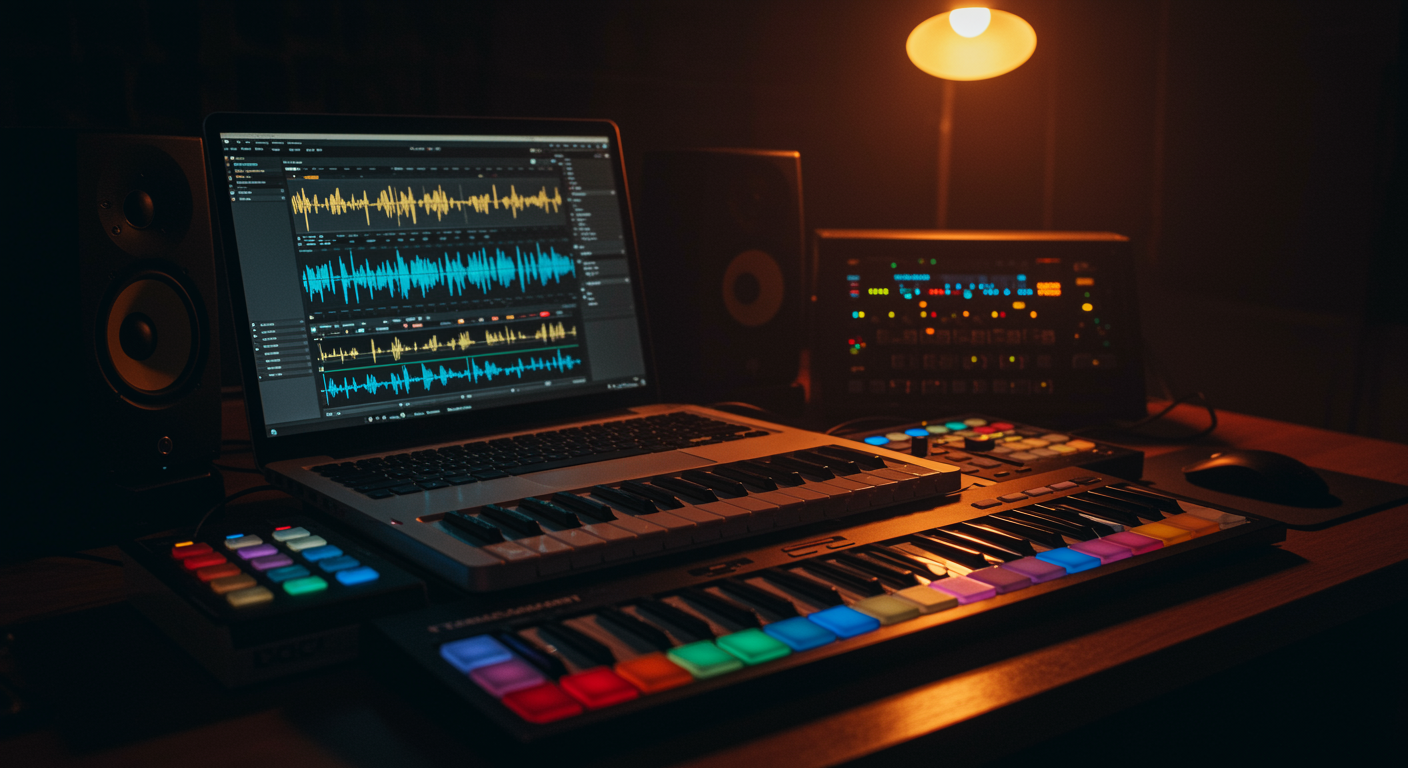
The choice of MIDI controller significantly influences the expressiveness and workflow when triggering samples in electronic music. Keyboards, from compact two-octave models to full-sized workstation controllers, offer a traditional piano-style interface, ideal for melodic and harmonic sample triggering. Their velocity-sensitive keys are perfect for introducing dynamic variation into percussion or instrument samples, while features like aftertouch can be mapped to continuous effects like vibrato or filter sweeps, adding depth post-trigger.
Drum pads, found on dedicated pad controllers or integrated into production stations, provide a tactile and often highly sensitive interface specifically designed for percussive sample triggering. Their typically larger, more robust pads are excellent for finger drumming, allowing producers to impart human feel and subtle timing variations. Many pad controllers also feature built-in sequencers, enabling intricate rhythmic patterns to be programmed and triggered with precision. Furthermore, unique controllers like MIDI guitars, wind controllers, or even motion sensors can translate different physical movements into MIDI data, opening up innovative avenues for triggering and manipulating samples in highly unconventional and dynamic ways.
Leveraging Velocity and Dynamics
Velocity sensitivity is perhaps the most fundamental and impactful MIDI sample triggering technique for injecting dynamism into electronic music. When a key or pad is struck, the speed at which it’s pressed generates a velocity value, typically ranging from 0 to 127. This value can be mapped to various sample parameters, most commonly volume, where a harder hit results in a louder sound, and a softer hit produces a quieter one. This direct correlation mimics acoustic instruments and is vital for creating natural-sounding grooves and expressive melodic lines.
Beyond simple volume control, advanced applications of velocity include mapping it to sample start points, filter cutoff, or even sample selection (velocity layering). For instance, a soft hit might trigger a subtle, sustained version of a sound, while a hard hit triggers a punchy, transient-rich variant, adding significant sonic variation. Producers can also use velocity to control envelope parameters, making a sound’s attack sharper or softer based on how it’s triggered. Mastering velocity control is essential for preventing static, robotic-sounding electronic music and instead crafting performances that breathe and evolve organically.
Advanced MIDI Mapping and Modulation
Moving beyond basic triggering, advanced MIDI mapping and modulation techniques unlock a vast palette of sonic possibilities for electronic music producers. MIDI Control Change messages (CCs) allow real-time manipulation of almost any parameter within a sampler or effect unit. Producers can map physical controls like knobs, faders, and joysticks on their MIDI controllers to filter cutoff, resonance, pan, delay send, LFO rates, or even sample crossfades. This dynamic control over multiple parameters simultaneously transforms static samples into evolving sound sculptures.
Modulation sources like LFOs (Low-Frequency Oscillators) can be triggered or synchronized via MIDI to create rhythmic or evolving changes to sample parameters. For example, an LFO controlling filter cutoff can be initiated by a MIDI note-on message, sweeping through the sample’s frequency spectrum with each trigger. Furthermore, techniques such as assigning aftertouch (pressure applied to a key after it’s initially pressed) or the modulation wheel to parameters like vibrato, tremolo, or distortion, allow for continuous, expressive control throughout the duration of a triggered sample. This intricate level of mapping is key to crafting unique, signature sounds that define contemporary electronic music production.
Sequencing Strategies for Sample Triggering
Sequencing plays a pivotal role in organizing and performing MIDI sample triggering techniques in electronic music, offering both precision and creative freedom. Step sequencers, whether hardware-based or within a DAW, allow for precise placement of MIDI notes over a grid, perfect for crafting intricate drum patterns or rhythmic melodic phrases from samples. These sequencers often include features for per-step velocity control, probability, and swing, which are crucial for injecting human feel and variation into otherwise quantized patterns. Combining multiple sequenced sample tracks can quickly build complex arrangements.
Beyond traditional step sequencing, more advanced strategies involve using generative or algorithmic sequencers that create MIDI patterns semi-randomly based on defined rules. This can lead to unexpected and dynamic sample triggering events, fostering new creative directions. Furthermore, live performance sequencing, where MIDI clips are triggered in real-time within a DAW’s session view, allows for spontaneous arrangement and improvisation with pre-prepared sample sets. This fluid approach to sequencing makes MIDI sample triggering a powerful tool for both studio production and live electronic music performances, enabling dynamic transitions and evolving sonic textures.
Software Samplers and Workflow Integration
Software samplers are indispensable tools for implementing diverse MIDI sample triggering techniques within a modern electronic music production workflow. DAWs like Ableton Live, Logic Pro, FL Studio, and Cubase come equipped with powerful built-in samplers (e.g., Live’s Sampler/Simpler, Logic’s Sampler), while third-party options like Kontakt, Serato Sample, or Falcon offer even deeper functionalities. To dive deeper into these virtual instruments, exploring various sampler plugins can open up new possibilities. These software instruments provide a flexible environment for loading, manipulating, and mapping samples to MIDI.
Effective workflow integration involves organizing sample libraries, creating instrument racks or drum kits, and meticulously mapping MIDI controls. Producers often build custom templates within their DAWs where specific samples or sample chains are pre-assigned to MIDI notes and performance parameters (like filters or effects) are pre-mapped to controller knobs. This preparation streamlines the creative process, allowing for immediate access to complex sound design and expressive MIDI sample triggering during composition or live performance. The seamless interplay between MIDI controllers, software samplers, and the DAW environment is critical for harnessing the full dynamic potential of sampled sounds.
Creative Applications and Sound Design
The true artistry of MIDI sample triggering lies in its creative applications for sound design and unique musical expression in electronic music. Beyond merely playing back sounds, producers use these techniques to transform raw audio into entirely new sonic entities. One common method involves layering multiple samples, triggered by the same MIDI note but with different velocity curves or modulation assignments, to create rich, evolving timbres. For instance, a subtle sine wave might be layered with a harsh metallic hit, appearing only at higher velocities, adding impact only when needed.
Another powerful application is ‘sample slicing,’ where a single audio file is chopped into many smaller segments, each mapped to a different MIDI note. This allows for deconstructing loops and re-sequencing them in novel, rhythmic, or melodic patterns, drastically altering the original context. Furthermore, MIDI sample triggering can be used for generative soundscapes by assigning random or algorithmic MIDI sequences to trigger ambient, textural samples with varying parameters, creating an ever-evolving sonic environment. Experimenting with unorthodox MIDI controllers, extreme parameter mapping, and combining various triggering techniques is key to pushing the boundaries of sound design and creating truly dynamic and original electronic music.