Convolution reverb is a powerful digital audio effect that meticulously recreates the unique acoustic characteristics of real-world spaces, particularly historical venues, by employing impulse responses (IRs) to achieve unparalleled realism and depth in music production.
What is Convolution Reverb?
Convolution reverb operates on a fundamentally different principle than its algorithmic counterparts. Instead of mathematically simulating reflections and decays, it digitally “samples” the actual sound characteristics of a physical space. This process involves mathematically combining an audio signal with an impulse response, which is essentially a recorded sonic fingerprint of how a specific room or environment reacts to a short, sharp sound. The result is an incredibly authentic and natural-sounding reverberation that carries the true acoustic signature of the sampled space, making it a cornerstone for achieving realism in music production. For producers keen on leveraging real-world acoustics, understanding natural reverb in sample production is essential.
The core concept revolves around the idea of capturing a space’s response to an impulse. These acoustic space samples are crucial in music production for capturing unique tones. When an audio signal is “convolved” with this captured response, the result is the dry signal sounding as if it were played within that sampled environment. This technique allows producers to place instruments or vocals within exact digital replicas of renowned concert halls, intimate clubs, vast cathedrals, or even custom-built recording studios, lending an immersive and believable quality to their mixes that traditional algorithmic reverbs often struggle to emulate.
The Science Behind Impulse Responses
An impulse response (IR) is a precise acoustic measurement that encapsulates how a particular space colors and reflects sound. Conceptually, it represents the complete journey of a sound from its source, bouncing off walls, ceilings, and floors, until it eventually decays. This data includes the earliest reflections, which give a sense of proximity and size, followed by the denser late reverberation that defines the overall decay and character of the room. The IR essentially models the propagation path and amplitude of every reflection within a given space over time.
To create an impulse response, a controlled sound, such as a sine sweep, a balloon pop, or a starter pistol, is emitted within the target environment. Simultaneously, one or more high-quality omnidirectional microphones record the sound and its subsequent reflections. This recorded audio file is then processed through a mathematical deconvolution algorithm, which extracts the pure acoustic signature of the room by removing the original emitted sound from the recording. The resulting IR file, typically a WAV or AIFF, can then be loaded into a convolution reverb plugin, allowing any dry audio signal to inherit the captured acoustic properties of that specific space.
Why Historical Venues Matter for Realistic Sound
The acoustic properties of historical venues are often highly coveted and play a pivotal role in creating truly realistic and evocative soundscapes in music production. Spaces like ancient cathedrals, grand opera houses, historic concert halls, and even centuries-old caves possess unique architectural designs, construction materials, and inherent reverberation characteristics that have evolved over time. These elements contribute to distinct sonic signatures that are impossible to replicate with generic algorithmic reverbs.
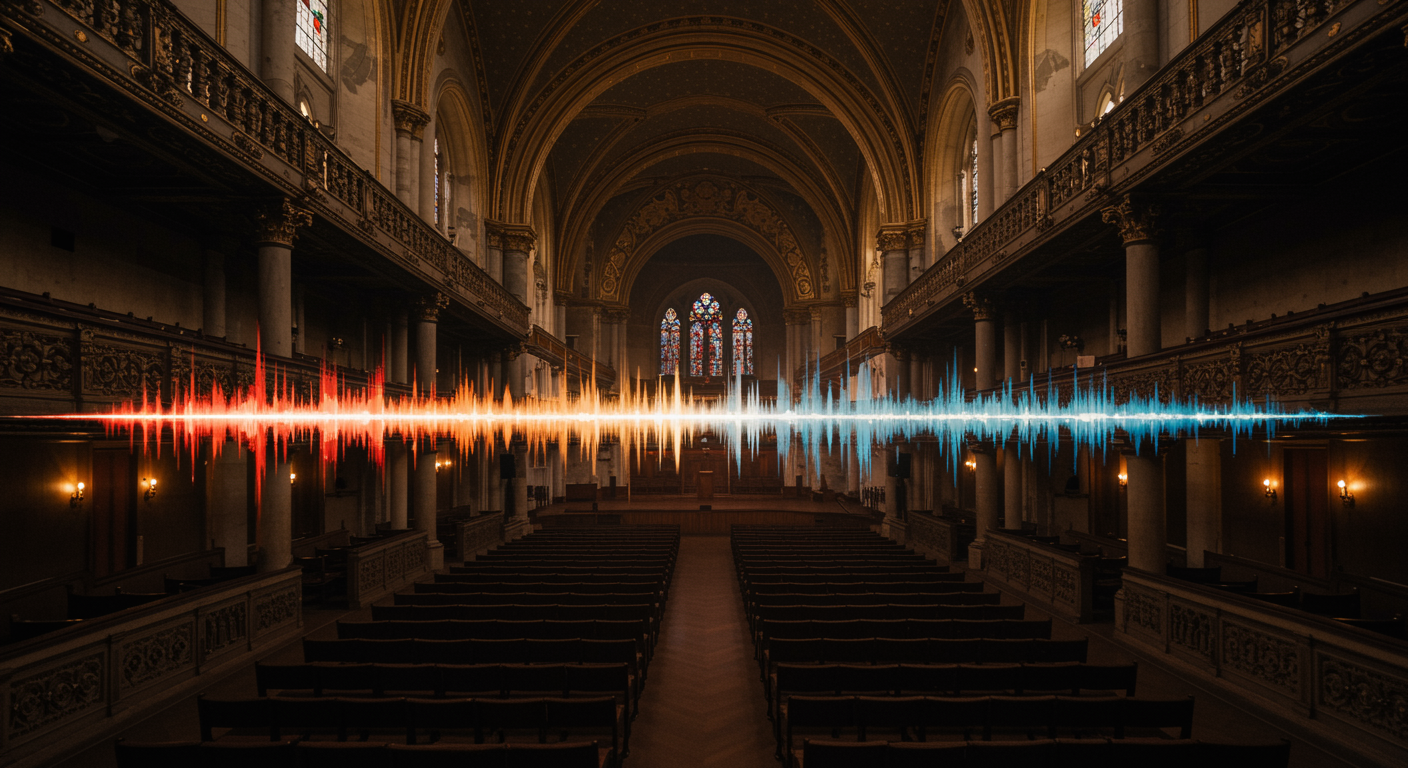
Capturing impulse responses from such historical venues allows music producers to imbue their tracks with a sense of “place” and authenticity that transcends simple echo. The natural resonance of a gothic cathedral, the warm embrace of a Baroque concert hall, or the expansive echoes of a Roman amphitheater can transport listeners, adding unparalleled depth and emotional resonance to musical arrangements. This pursuit of creating depth and space in audio is also a key aspect of binaural audio samples. Utilizing these authentic historical venue impulse responses provides not just a sound effect, but a tangible connection to the past, making the sonic experience richer and more immersive for the audience.
Capturing Impulse Responses: A Detailed Look
The meticulous process of capturing high-quality impulse responses is critical for harnessing the full potential of convolution reverb. It begins with selecting the right excitation signal. While a sharp clap or balloon pop can work for basic captures, a sine sweep is generally preferred for its ability to excite all frequencies evenly. This involves playing a sine wave that continuously sweeps through the entire audible spectrum within the chosen space.
Equipment selection is paramount. High-fidelity, omnidirectional condenser microphones are ideal for their flat frequency response and ability to capture sound from all directions, mirroring how sound propagates in a real environment. These microphones are typically paired with pristine preamps and high-resolution analog-to-digital converters to ensure an uncolored and accurate recording. Multiple microphone positions are often used to capture variations in the room’s response, offering greater flexibility when mixing. Environmental control is also crucial; the space must be absolutely silent during the capture to avoid unwanted noise. Once recorded, the sweep data is then “deconvolved” using specialized software, transforming the raw recording into a usable impulse response file that perfectly embodies the room’s acoustic signature.
Integrating Convolution Reverb into Music Production
The strategic integration of convolution reverb is a game-changer for music producers aiming for realism, cohesion, and emotional impact. Unlike simply adding a generic echo, applying a carefully selected impulse response from a historical venue can place individual instruments or an entire mix within a believable, shared acoustic environment. For vocals, a subtle church or hall IR can add ethereal presence and depth without washing out the performance. Drums can gain powerful spatial context, sounding as if they were recorded in a grand hall, giving them a more authoritative and immersive feel.
Producers often utilize convolution reverb on send/aux tracks to process multiple instruments through the same IR, unifying them within a single acoustic space and enhancing the sense of blend. This technique is particularly effective for orchestral arrangements, where it can simulate the experience of a live performance in a concert hall. Beyond realism, convolution reverb also serves as a potent tool for sound design, allowing for creative placements of sounds in unusual or exaggerated environments, lending unique character and narrative to the music. The judicious choice of an impulse response, considering its decay time, character, and density, is key to enhancing the musicality and sonic realism of any production.
Beyond Realism: Creative Applications of Impulse Responses
While convolution reverb excels at replicating real-world acoustics, its utility extends far beyond mere realism. Music producers and sound designers frequently explore unconventional uses of impulse responses to craft unique sonic textures and soundscapes that defy naturalistic expectations. This involves experimenting with IRs not derived from traditional acoustic spaces.
For instance, an IR can be captured from an object like a metal pipe, a cardboard box, or even a spring reverb unit, then applied to a dry signal to impart entirely new tonal qualities and resonant characteristics. These unconventional IRs are akin to found sound samples, often explored in experimental electronic music for creative sound design. Layering multiple IRs, each contributing a different aspect of decay or early reflection, can forge hybrid spaces that are imaginative and otherworldly. Furthermore, impulse responses can be used to process non-audio signals, such as photographs or video data, converting visual information into sonic textures. This creative approach transforms convolution reverb from a tool for imitation into a powerful instrument for abstract sound design, opening up vast possibilities for sonic exploration in music production, film scoring, and experimental audio art.