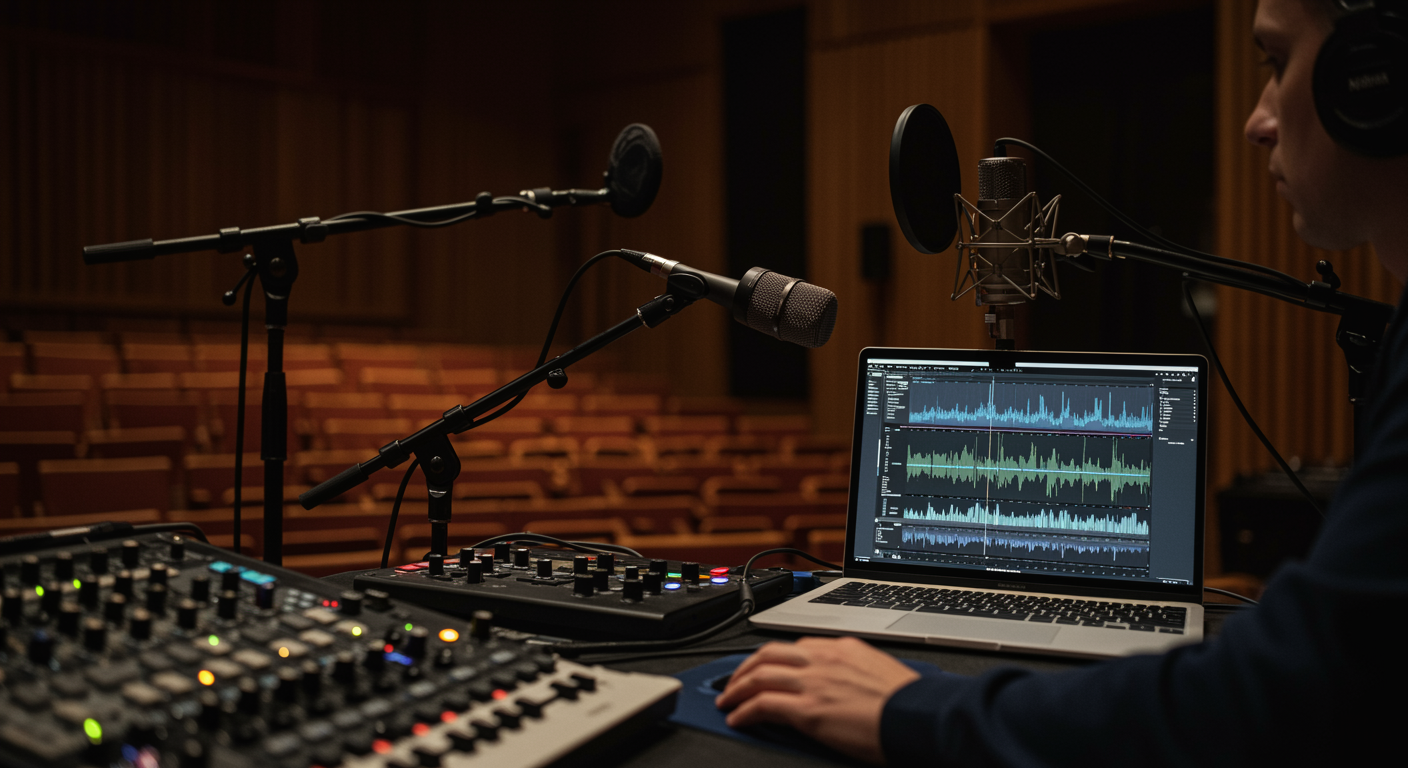
Acoustic space samples, encompassing impulse responses and ambient room tones, are fundamental music production techniques for imbuing tracks with unique spatial characteristics and authentic environmental depth. They involve capturing the sonic fingerprint of a specific physical space, which can then be applied to instruments and vocals using convolution reverb or integrated creatively into sound design to enhance realism, add character, and achieve distinct spatialization.
Understanding Acoustic Space Samples
Acoustic space samples are digital recordings that encapsulate the unique sonic characteristics of a physical environment. Broadly, these can be categorized into two main types: impulse responses (IRs) and ambient room tones. Impulse responses are essentially a measurement of how a specific room responds to a sharp, transient sound, capturing its reverberation, reflections, and early reflections. They provide a precise blueprint of the space’s acoustic properties, allowing producers to virtually place any sound within that exact environment. Room tones, conversely, are recordings of the subtle, inherent background noise and atmosphere of a space when no specific sound event is occurring. They offer a sense of environmental presence, adding a layer of authenticity and often a touch of the characteristic “color” of a location.
The significance of employing these samples in music production lies in their ability to transcend generic digital reverbs. While algorithmic reverbs can simulate spaces, an actual acoustic sample provides an undeniable realism and unique sonic signature that is difficult to replicate. This technique allows producers to transport listeners to a grand concert hall, a claustrophobic stairwell, a vast cavern, or even a specific vintage recording studio, all from within their digital audio workstation. Beyond mere realism, these samples serve as powerful creative tools, offering a palette of textures and spatial dimensions that can dramatically influence the mood and impact of a musical piece, making them indispensable for advanced sound design and mixing.
Techniques for Capturing Impulse Responses
Capturing high-quality impulse responses is a precise art that requires careful planning and execution. The fundamental principle involves playing a full-frequency “sweep” tone or a sharp, transient sound (like a clapper or starter pistol) in a space and recording its acoustic response. To begin, select a room or environment with unique or desirable acoustic properties. Essential equipment includes a high-quality condenser microphone (or a stereo pair for true stereo imaging), a robust audio interface, and a studio monitor capable of reproducing a wide frequency range. The microphone placement is crucial; multiple positions throughout the room can yield different IRs, capturing varying early reflections and decay characteristics. Often, a “speaker at the listening position, mic in the room” or vice-versa setup is used.
For the excitation signal, a sine wave sweep is commonly preferred due to its broad frequency coverage and ability to reveal complex room resonances without clipping. Specialized software can generate these sweeps and then deconvolve the recorded response to extract the pure impulse response, stripping away the original sweep signal. Alternatively, a sharp, broadband transient sound like a clap, balloon pop, or a specially designed “IR gun” can be used, which simplifies the capture process but might require more careful editing to isolate the impulse. Ensuring the room is as quiet as possible during recording is paramount, as any external noise will be embedded into the IR, compromising its purity and usability. Multiple takes from different positions and distances are recommended to build a versatile library of spatial data for a single environment.
Recording Ambient Room Tones and Field Recordings
While impulse responses focus on a room’s reverberant qualities, ambient room tones and broader field recordings capture the subtle, living essence of a space. These recordings are not about how a sound decays but rather the inherent “silence” or background hum of an environment. To record effective room tones, silence is key; choose a time when the chosen location is at its quietest, free from immediate distractions like traffic, people talking, or HVAC systems cycling on. Microphone selection is critical here, with omnidirectional microphones often preferred for their ability to capture the entire spherical sound field, providing a more immersive and less directional sense of space. Stereo microphone configurations, such as an XY pair or ORTF, are excellent for capturing a natural stereo image of the ambient soundscape. Learning about various field recording techniques can further enhance the quality of your ambient captures.
Implementing Acoustic Samples in Production
The primary method for integrating acoustic space samples into music production is through convolution reverb plugins. Unlike algorithmic reverbs that synthesize a reverb sound, convolution reverbs use an actual recorded impulse response. When an IR is loaded into a convolution reverb plugin, it essentially “convolves” (mathematically merges) the dry audio signal with the impulse response, making the dry signal sound as if it were played within the space where the IR was recorded. This process instantly adds the unique early reflections, decay, and overall character of that specific acoustic environment to your sound, creating a highly realistic and immersive spatial effect. Producers can apply distinct IRs to different elements of a mix, such as a short, tight room IR on drums for punch, a medium hall IR on vocals for breadth, and a longer, ambient IR on pads for atmosphere, to craft a cohesive yet spatially diverse soundstage.
Beyond traditional reverb applications, ambient room tones offer unique benefits. They can be subtly layered into a mix, often at very low volumes, to “glue” together disparate tracks and give the entire production a sense of being recorded in a single, unified space. This technique can be particularly effective in film scoring or sound design, where establishing a consistent environmental context is crucial. Furthermore, room tones can be used as creative textural elements, processed with EQ, compression, or modulation effects to generate drones, pads, or percussive accents. By meticulously selecting and applying acoustic space samples, producers gain an unparalleled level of control over the spatial dimension of their music, transforming a collection of individual sounds into a unified, breathing sonic landscape with depth and character.
Creative Sound Design with Unique Spatial Data
The utility of acoustic space samples extends far beyond merely recreating realistic reverb; they are potent tools for creative sound design. By applying impulse responses to unconventional sound sources, producers can achieve surprising and unique textures. For example, routing a synthesizer pad or a drum loop through an IR of a small metal container or a long, winding tunnel can completely transform its character, injecting it with an entirely new spatial identity and tonal color that an algorithmic reverb could never replicate. The unusual resonances and short, complex decays captured in such specific IRs can create percussive effects, metallic shimmers, or eerie, otherworldly ambiances. This technique allows for experimentation with the “body” or “container” of a sound, treating the space itself as an instrument. For producers looking to push boundaries, exploring advanced acoustic sample manipulation techniques in their DAW can unlock even more innovative possibilities.
Furthermore, manipulating impulse responses and room tones directly opens up a vast realm of creative possibilities. Reversing an IR before convolution can lead to intriguing pre-verb effects, where the reverb swells before the dry signal. Gating the convolution reverb, time-stretching the IR, or even pitching it up or down can generate abstract sound effects, rhythmic textures, or evolving soundscapes. Room tones, when processed heavily with granular synthesis soundscapes, extreme equalization, or distortion, can evolve from subtle background presence into prominent, characterful elements that drive the atmosphere of a track. By breaking away from the conventional use of these samples, producers can harness the unique spatial data they contain to craft truly innovative and distinctive sonic narratives, pushing the boundaries of traditional soundscapes and spatial effects in music production.
Optimizing Sample Quality and Workflow
To maximize the impact and versatility of acoustic space samples in music production, optimizing their quality and streamlining the workflow is essential. The first step towards quality is capturing clean recordings. For both impulse responses and room tones, meticulous attention to microphone placement, ensuring a low noise floor in the recording environment, and using high-quality preamps are crucial. Any unwanted hums, clicks, or background chatter captured during the recording phase will be embedded into the sample and can degrade its effectiveness when applied in a mix. Post-capture editing is also vital; this includes precise trimming to remove any dead air or pre-roll, gentle noise reduction if absolutely necessary (though often best avoided for IRs to preserve authenticity), and normalizing levels without introducing distortion.
Developing an organizing sample library of acoustic space samples significantly enhances workflow efficiency. Categorizing samples by environment type (e.g., “small room,” “large hall,” “outdoor,” “metallic,” “unusual”), by unique characteristics (e.g., “short decay,” “bright,” “dark,” “dense”), or by source (e.g., “my recordings,” “commercial packs”) allows for quick retrieval during creative sessions. Consistent naming conventions are also key. When integrating samples into a mix, consider layering different IRs or combining a convolution reverb with an algorithmic one to achieve a more complex and nuanced spatial effect. Applying subtle EQ to the convolution reverb’s output can help it sit better in the mix, either brightening it or taming harsh frequencies. Experimentation with wet/dry ratios and pre-delay settings allows for fine-tuning the spatial feel, ensuring that the acoustic samples enhance the production without overpowering it, thus elevating the overall sonic experience.