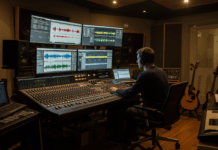

In the world of music production, reverb effect plugins are indispensable tools that breathe life into your tracks. They replicate the natural reverberation of sound in various environments, enriching audio with depth and ambiance. Whether you’re crafting a lush soundscape or simply adding subtle texture, understanding the diverse types of reverb plugins available—both digital and analog—can greatly enhance your productions. This overview delves into the essential features, compatibility, and innovative technologies behind reverb plugins, providing a foundational understanding crucial for both budding producers and seasoned sound engineers alike. Join us as we explore this vital aspect of audio production, ensuring your mixes resonate with that perfect atmospheric touch.
Overview of Reverb Effect Plugins
Reverb effect plugins are essential tools in music production, simulating the persistence of sound created by reflections in various environments. Their role is crucial for adding depth and ambiance, transforming dry recordings into immersive audio experiences.
Different reverb plugins are designed for a wide range of applications, from enhancing vocals to enriching instrumentals. The right plugin can significantly alter the feel of a track, making it sound spacious or intimate, depending on the desired effect. Compatibility is an important consideration; most plugins support popular digital audio workstations (DAWs), ensuring easy integration into any workflow.
Reverb plugins typically fall into two categories: algorithmic and convolution. Algorithmic reverb uses mathematical algorithms to generate reverb effects, offering extensive customization options. Convolution reverb, on the other hand, captures the acoustic characteristics of real spaces using impulse responses, providing more authentic and realistic results.
Innovative technologies in reverb plugins have led to advanced features, such as adjustable decay rates, early reflections, and customizable damping, allowing music producers to shape their sound with precision.
Understanding reverb effect plugins and their functionality is key for any music producer looking to elevate their tracks. Choosing the appropriate type of reverb based on the sound you aim to achieve can make a notable difference in your overall mix.
Types of Reverb Plugins
Reverb plugins can generally be categorized into two primary types: algorithmic and convolution. Understanding these categories is crucial for producers seeking the desired sound in their projects.
Algorithmic reverb utilizes mathematical algorithms to create reverb effects. This type offers flexibility and extensive customization, allowing producers to shape the reverb to fit their unique sound. Algorithmic plugins often come with adjustable parameters for decay time, pre-delay, and early reflections, making them suitable for a wide range of applications. Their adaptability in real-time makes them a favorite for many producers.
On the other hand, convolution reverb mimics real-world acoustics by using impulse responses (IRs) recorded from actual spaces. This means that the reverb you hear closely resembles how sound behaves in various environments, from small rooms to large halls. While convolution reverb provides a higher degree of realism, it often comes with a heavier CPU load, especially when utilizing extensive libraries of impulse responses.
Several popular types of reverb plugins deserve special mention:
Plate Reverb: Known for its smooth, dense sound, plate reverb mimics the acoustic properties of large metal plates. It’s often used for vocals and instruments needing a lush, atmospheric quality.
Spring Reverb: This type recreates the sound of vibrating springs. Spring reverbs are typically more compact and can add a warm, vintage character to sounds, making them ideal for guitar effects.
Hall Reverb: Designed to simulate the reflections and resonance found in concert halls, this reverb is great for adding space and depth to mixes. It is often used in orchestral and choral arrangements.
Room Reverb: More subtle than hall or plate reverb, room reverb provides a quicker decay time, making it perfect for achieving a natural, intimate sound in recordings.
Each reverb type has its unique characteristics and applications, helping sound designers determine the best fit for specific projects. Understanding these options allows producers to harness the full potential of reverb in their music production endeavors.
Popular Reverb Plugins in the Audio Industry
The audio industry showcases a range of reverb plugins that have gained popularity for their quality and versatility, catering to various production needs.
Valhalla VintageVerb stands out as a top-rated reverb plugin, celebrated for its lush, warm sounds reminiscent of vintage hardware. Its multiple modes, including hall, plate, and room reverbs, provide immense flexibility, accommodating both modern and classic applications.
Eventide Blackhole is another powerhouse in the realm of reverb. Known for its expansive soundscapes, it allows users to push the boundaries of traditional reverb effects. The plugin excels in creating massive atmospheric spaces, making it ideal for cinematic and experimental music projects.
FabFilter Pro-R is often highlighted for its user-friendly interface and innovative features. It incorporates a unique Decay Rate EQ, enabling precise tonal shaping of reverb tails. This makes it suitable for a wide array of applications, from vocals to orchestral arrangements.
In the realm of free reverb options, plugins like TAL-Reverb-4 and Valhalla Supermassive offer impressive sound quality without a price tag. TAL-Reverb-4 provides classic plate reverb effects, especially favored for drums and percussive elements, while Valhalla Supermassive blends reverb and delay for creative soundscapes.
Overall, selecting the right plugin boils down to the desired application and sound character. Each of these popular reverb plugins showcases unique features that can significantly enhance audio productions, whether it’s for a stellar vocal treatment or creating immersive sonic environments.
How to Use Reverb in Music Production
Understanding key reverb parameters is crucial for effectively utilizing this powerful effect in music production.
Three essential settings to focus on are decay time, pre-delay, and dry/wet balance.
Decay Time: This controls how long the reverb lasts after the sound source stops. A longer decay creates a sense of space but can muddy the mix if overused; a shorter decay maintains clarity.
Pre-Delay: This setting determines the time between the original sound and the first reverb reflections. Adjusting pre-delay can help give instruments room to breathe, particularly for vocals and percussive sounds. A slight pre-delay (around 20-30 ms) often enhances clarity.
Dry/Wet Balance: This adjusts the mix of the original (dry) sound to the reverberated (wet) sound. Finding the right balance is vital; too much reverb can drown out the main elements, while too little may not achieve the desired spacious effect.
Here are some practical tips to apply these settings effectively:
Experiment with Decay: For vocals, try a medium decay time of 1.2 to 2 seconds for a natural sound. For atmospheric or ambient tracks, longer decay times can create a lush space.
Use Pre-Delay Creatively: For percussive elements, a pre-delay of 10-20 ms can help the attack of the sound stand out more clearly against the reverb.
Consider Grouping Instruments: Utilize auxiliary tracks for reverb effects on similar instruments, such as all vocals or drums, allowing for a cohesive sound while saving CPU resources.
Optimizing these parameters helps enhance clarity and prevent muddiness in your mixes, allowing for professional-sounding results.
Creative Applications of Reverb Effects
Reverb’s creative potential is vast, especially in sound design and electronic music, where it can sculpt immersive environments.
Producers frequently use reverb to build expansive soundscapes that transport listeners. By adjusting the decay time and pre-delay settings, one can create lush atmospheres that feel deep and dimensional.
In electronic music, reverb can blend elements seamlessly, enhancing transitions between sections. For example, applying a long reverb tail on a synth pad can create a rich, evolving backdrop, allowing for smooth progression.
Utilizing reverb in unconventional ways can lead to unique audio effects. Experimenting with extreme settings—like heavy filtering combined with short decay times—can yield unexpected results, perfect for sound design.
Exploring specific techniques like reverse reverb can produce tension-building effects, ideal for buildup moments in tracks. This approach can make sounds feel as though they are rushing toward the listener, creating anticipation.
Additionally, reverb can be layered with other effects such as delay or distortion to achieve complex textures that enrich the overall sound.
By embracing these creative avenues, producers can elevate their compositions, allowing reverb to become an essential tool for crafting memorable audio experiences.
In conclusion, understanding reverb effect plugins is essential for any music producer or sound engineer looking to enhance their projects. These plugins simulate various acoustic environments, adding depth and atmosphere to your sound, which can significantly elevate your productions.
As we’ve explored, there are different types of reverb effects, each with unique characteristics tailored for specific uses.
Comparing the best reverb plugins can help you identify the ideal choice for your needs, while practical tips on how to effectively use these tools can make a world of difference in your mixing process.
Furthermore, considering user experiences can guide you through common challenges and recommend the right plugin for varying scenarios.
Ultimately, embracing the rich capabilities of reverb effect plugins can profoundly impact the quality of your music, making it not just sound good, but feel good too.
FAQ
Q: What is reverb in audio production?
A: Reverb simulates the persistence of sound in a space created by sound wave reflections. It’s essential for adding depth and ambiance to recordings.
Q: What are the different types of reverb plugins?
A: Common types of reverb plugins include hall, chamber, plate, spring, convolution, and room reverbs, each designed for specific sonic effects.
Q: How do algorithmic and convolution reverb differ?
A: Algorithmic reverb uses mathematical models for customization, while convolution reverb employs real acoustic recordings for realistic effects.
Q: What are some popular free reverb plugins?
A: Popular free plugins include Variety of Sound’s epic reverbs, Spectral Plugins Spacer, and TAL-Reverb-4, each offering unique sound characteristics.
Q: What factors should I consider when choosing a reverb plugin?
A: Consider the plugin’s type, user interface, features, compatibility with your DAW, and the specific audio application you have in mind.
Q: How can I effectively use reverb in music mixing?
A: Adjust settings like decay time and pre-delay, and utilize aux tracks to optimize CPU resources while enhancing depth in your mix.
Q: What challenges might I face when using reverb plugins?
A: Users may encounter issues like muddy mixes or CPU overload. Balancing settings is crucial to prevent these common pitfalls.
Q: How do reverb plugins enhance audio production?
A: Reverb plugins enrich recordings by simulating various environments, making sounds appear more immersive and spacious in a mix.